



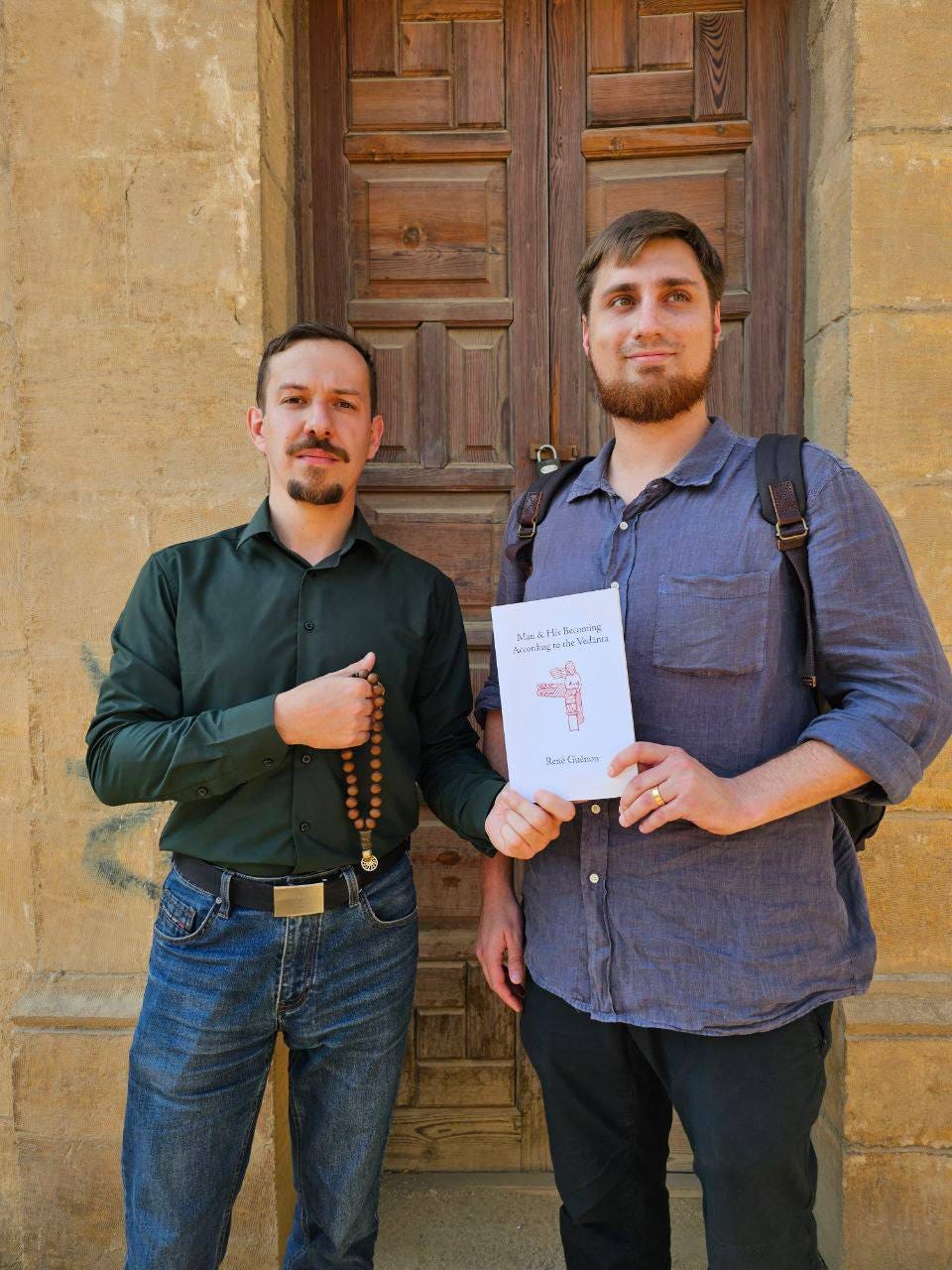
Some 138 years ago, on November 15, 1886, René Guénon was born. In October 2025, PRAV Publishing’s Editor-in-Chief, Dr. Jafe Arnold, and Evgeny Nechkasov (Askr Svarte), PRAV author and co-editor of Passages: Studies in Traditionalism and Traditions, traveled to Guénon’s tomb in Egypt.
Below, readers will find (I) Arnold’s account of the roundabout journey to reach Guénon’s tomb and (II) a textual translation of Nechkasov’s discourse at Guénon’s tomb, followed by the on-site video.
I.
One does not simply visit René Guénon’s tomb in Cairo.
We tried this morning, to no avail. After asking around and finally making our way to the vicinity, all the entrances in the “City of the Dead” turned out to be locked. The most we got was “Inshallah” from a passer-by who said that we might succeed in the afternoon if we come back when one of the families is visiting a grave nearby. We retreated to some shade and meditated with spirit.
Accepting the situation as impassable, we decided to hitch a ride to visit the Coptic Church of St. Simon in the outskirts of Cairo. The ‘tuk-tuk’ driver we flagged down didn’t understand, so he took us to some mosque instead. When we finally managed to reorient our route, we in our little tuk-tuk made our way through the “City of Trash,” a slum whose inhabitants, mostly Christians, survive entirely off the waste of Modernity. The sight was worse than the smell.
Finally at St. Simon’s, our visit to the main hall, carved into the side of the cliff, was interrupted when we were thrown out to make way for an incoming funeral service. The cries and wails of the women, ear-piercing and hypnotic like sirens, plunged us into a feeling of the most archaic levels of culture — mourning, death, the human voice crying out into the abyss.
As we made our way to another hall, this one dug deeper into the rock so as to constitute a full cave, we noticed an inscription which read: “IN HIM WE HAVE OUR BEING.” This led us to sit down and reflect on Being, the difference between Being and beings, the relation between Platonism, Vedanta, Christianity, and Heidegger.
And thus, several hours later, drenched in sweat, scorched by the sun, smelling like the City of Trash, and provoked into thought by the wails and theology of Coptic Church caves, we resolved to try to visit Guénon again — or rather anew.
Alas, to no avail. Everything was closed. Our only hope seemed to be a man a street down, whom we had greeted along the way of our first attempt in the morning. When we turned up at his cigarette stand, which turned out to be the entrance to his “house” (some bedding between tombs), he was delighted to see us and invited us in with the fullest smile. When we managed to communicate our attention to visit the tomb of Abd al-Wāḥid Yaḥiā, he showed us a set of keys and instructed us to sit down and wait. He proceeded to speak to us in Arabic the whole time, knowing fully well that we did not understand. He offered us various leaves from his garden, coffee, tea, cigarettes, and finally, via Google Translate, explained to us that he is a smith — he used to work with gold and silver, now he works with iron locks. The mythological correspondence is unmistakable, and yet questionful…
Eventually, probably just under an hour later, the stars aligned: he grabbed his keys, beckoned us forth, and led us to a gate — opposite of the one where we had been told we would find the way to Guénon’s tomb — and walked us through the labyrinth to the resting place. We communicated our wish for 30 minutes to pay our respects, but he insisted that he stay to ward off thieves.
And so, under his watchful gaze and with his attentive listening, we paid our respects, we filmed a short monologue on the past and future legacy of Guénon and Traditionalism, and we bid farewell to the great thinker whose thinking brought us together and brought us here.
Of course, our “guide” refused any money for his hospitality and assistance. In a seeming instant, he disappeared. Just a few minutes later, when we walked by his “station” again, he was nowhere to be found. The door was locked.
Thus, one does not simply visit René Guénon’s tomb. One must be seasoned and experienced — “seasoned” not in the sense of having many experiences, but rather of being ready for the right season, the right time, the kairos, the Ereignis; “experienced” not in the sense of having had many experiences, but rather of being open to experiencing that which arises on our path, or which suddenly constitutes our path.
After all, the greatest teaching that Guénon bestowed upon us, a teaching that brought a Russian and an American to wander the “City of the Dead” and “City of Trash” in Egypt, is not a stale doctrine of holy dogma. Rather, it is the imperative of living, seeking, and reaffirming the sacred precisely when it is most obscured and seemingly inaccessible. “Tradition” is not a definition in Guénon’s books; it is the transmission of this quest and the ways of being and thinking that traverse it. “Traditionalism” is not a discourse upon Guénon’s verbiage; it is sacrocentric traveling, with due respects to be paid to those who have forged paths for us, which we must fare again and anew, wherever they lead.
— Jafe Arnold [October 15-16, 2025]
II.
Today we’re in Cairo, in the City of the Dead. We find ourselves at the grave of the French philosopher René Guénon, a man who basically doesn’t need any introduction, a person whose works laid the foundations of what later came to be known as the philosophy of Traditionalism.
The philosophy of Traditionalism, despite all the debates over the existence of such an “-ism”, already exists for more than half a century, virtually close to a century.
To date, Traditionalism has turned from an individual doctrine of Guénon’s into a very broad school which, like any great philosophy, has its own currents and so-called stages of development. There de facto exists something that could be called “classical Guénonism”, a position that is concentrated around Guénon’s books and specific personal opinions on various questions.
Commentary on and polemics with René Guénon began already with Julius Evola. Subsequently, various primary and secondary authors vested Traditionalism with their own additional interpretations, with the methods of Traditionalism for the hermeneutics of different cultures, for the interpretation of Traditionalism itself as a philosophy, clarifying and adjusting its methods. There’s been a revision of some of Guénon’s own provisions and a correction of certain inherent distortions and effects of Modernism, which Guénon himself perhaps didn’t reflect upon, yet which are present in his works.
Today, from my standpoint, I would divide Guénon’s Traditionalism into two levels or two components. There is the core: fundamental, metaphysical sacrocentrism, posing the sacred, tradition, and its language in the center. And there is the outer layer of Guénon’s own comments, his individual opinions, his personal preferences and life path — that which is the most controversial or even irrelevant from the perspective of Traditionalism today. Nevertheless, retaining the intention of sacrocentrism, Traditionalism has traversed a great path of expansion and self-development. The Traditionalism that we know and have today has gone very far from its founder.
Personally speaking, as an author, I would say that what draws me to Guénon is a rather small set of his theses which pertain to the fundamental core of sacrocentrism. But posing the question of the possibility of the sacred in our epoch, which Guenon didn’t live to see, compels us to carry out a deeper revisionism of what is known as Traditionalism and to reconcile it with a Heideggerian reading of the problem of the sacred, with how we can re-pose the question of the possibility of the sacred in our epoch anew, on even deeper foundations, in connection with the problem of the interpretation of Being itself.
Therefore, for my part, I’ve tried to comparatively set up and formulate this problem in the book Towards Another Myth.
Today, once again speaking for myself, we are visiting René Guénon so as to, on the one hand, express respect for what he established, and on the other hand, to bid farewell to his personal position in order to continue our path independently and to follow — or research — the problem of Sacred Being in conditions which were not at hand for Guénon himself, nor for tradition as such.
— Evgeny Nechkasov (15 October 2025)