



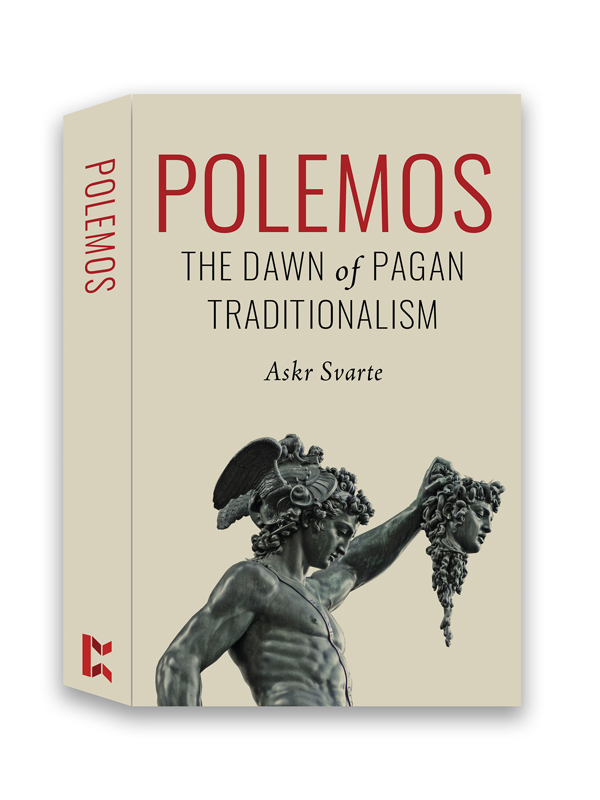
It is no coincidence that the book which you are holding in your hands has as its main title the word Polemos. This, along with the subtitle, “The Dawn of Pagan Traditionalism”, should be understood as an open question and invitation to be immersed and participate in numerous parallel, intersecting, and surrounding studies and debates on the contemporary state of (neo-)paganism in the world.
It is also important to note that this book stands on the shoulders of many other important predecessors and their works. Particularly noteworthy is the approach of Alain de Benoist and his book, On Being a Pagan, with the consideration of the critiques of the latter offered by Collin Cleary. Of no less importance are the general contributions of René Guénon, who throughout his works, both before and after his symbolic conversion to Islam, relied on the doctrines of the Vedas, the most detailed expression of pagan metaphysics in the space of India and Asia.
At the very core of this work lies the spirit of the Italian thinker Julius Evola, who comprehensively substantiated the possibility of Traditionalism in an active form and brought to this philosophy’s field of consideration numerous other traditions and schools. Although we may not agree with the Baron in some places on matters of specific details and evaluations, nevertheless, his volitional spirit in affirming the truth, no matter what and against all odds, inspired many of the lines of this work.
Nor should we overlook such a purely Russian phenomenon as the Yuzhinsky school of metaphysics that emerged out of a circle of radical philosophers, mystics, and poets who, in the late 20th century USSR, discovered the philosophy of Traditionalism for Russia, corrected some of René Guénon’s misconceptions, and proved capable of posing more radical metaphysical and existential questions. Without a doubt, the poetic and creative myth-making influence of the works of Evgeny Golovin, as well as references to the works and methodologies of Alexander Dugin and his sociological paradigm of Traditionalism, can be found in this book – with, of course, due recognition of our opposite views on the metaphysics of the Abrahamic religions.
We see a unique, positive point in the fact that this work was written in Russia and in Russian. First of all, this adds to pan-European Traditionalist discourse the great Slavic-Russian field of thought and its corresponding linguistic specificities. Secondly, in modern Europe and North America the development of paganism in the 20th century bore the effects of numerous false and erroneous doctrines and positions, whereas in Russia, for example, the Russian-speaking branch of Asatru has based itself on more reliable historical, archaeological, folkloric, and linguistic data than the flights of fantasy of late 19th and early 20th century European occultists. In other words, for objective reasons some European misconceptions concerning Tradition have not been perpetuated here, which makes our view somewhat purer. Thirdly, in connection with the latter point, the emergence of pagan movements in the late USSR and in the new Russia was also to a fairly notable extent tainted by our own local pseudo-pagan movements, which have speculated on Slavic-Russian and European mythologies and mixed them with New Age doctrines and the outright lies of newly-minted gurus. These pseudo-Slavic cults subsequently began to be exported to Europe and other countries, thus yielding a paradoxical situation in which Slavic-Russian paganism has been presented to and across the world through those same pseudo-pagan speculations which adequate and competent representatives of Rodnoverie (Native Faith) here in Russia have been struggling against for many years. Hence why our book devotes so much attention to the analysis and history of these pseudo-pagan currents, so that Western readers may have the minimally necessary starting orientations to be able to distinguish lies from truth for themselves.
The latter question is related to the even greater problems explored in this book, such as the relation of paganism to Modernity with its whole complex of sciences, technologies, and arguments, the ironic suggestions of Postmodernity with its propositions of universal mixing and the final dissolution of meanings and hierarchies, as well as, importantly enough, the polemicizing and deconstruction of Abrahamic influences on pagan traditions and Traditionalism in general.
The two-volume work Polemos was finished in the spring and published in the fall of 2016. In the time which has passed since then, some situations have changed. Some movements and prospective currents of thought have come to a halt, while other, previously unnoticed ones have begun to manifest themselves. Moreover, several of the iconic personalities discussed in this book have since passed on to other worlds, such as Nikolai Speransky, a.k.a. Velimir, in 2018, the ideologist of Greek paganism Vlassis Rassias in 2019, and the writer Lev Prozorov, a.k.a. Ozar Voron, in 2020. If rewritten now, this book would stand to gain from paying more attention to new authors, figures, theologians, and poets of contemporary paganism. It would behoove us to dwell in more detail on contemporary instances of Pagan Traditionalism, such as the Roman Traditional Movement (MTR) in Italy, the Supreme Council of Ethnic Hellenes (YSEE) in Greece, on neo-paganism in the Caucasus, particularly Armenia, on the survival of the last pagans of the Hindu Kush in the Chitral valley, on the situation of contemporary shamanism, the complex palette of traditions among the indigenous peoples of Russia, such as the Ossetians, Mari, Buryats, and others, as well as, finally, on covering the religious situation in Latin America, Africa, and Oceania. We have already filled some of these gaps in our other, more recent interviews, articles, journals, pamphlets, and books.[1]
Of course, every author is condemned to face such a situation when addressing and relying on illustrations and examples from the transient contemporary world. Thus, in our opinion, of the greatest importance is understanding the methods and procedures which we have declared here to be the foundations of Pagan Traditionalism. It is important to understand the thinking and nuances of paganism in the conditions of the Postmodern world and the existential nerve of paganism’s struggle for purity and authenticity. This is the matter to which the greater part of this book is devoted. We have since developed many of the individual topics raised in the first chapters in detail in our other works, but the foundations were and are laid here.
As we said at the very outset, this work is an invitation to cooperative reflection and practice. Pagan Traditionalism is potentially fertile soil for all those pagan traditions in all the different corners of the world which are struggling for their identity, purity, and their very existence and being.
[1] See: Askr Svarte, Priblizhenie i okruzhenie. Ocherki mysli o Germanskom Logose, Traditsii i Nichto [Forthcoming and Encirclement: Thoughts on the Germanic Logos, Tradition, and Nothingness] (Novosibirsk: Svarte Aske, 2017; Moscow: Gnosis, 2020); Identichnost’ iazychnika v XXI veke [Pagan Identity in the 21st Century] (Moscow: Veligor, 2020); Gap: At the Left Hand of Odin (Fall of Man, 2019); “The Kalash People and their Identity” (Novosibirsk: Svarte Aske, 2019). See also the volumes of the Traditionalist almanac Warha (Russian edition) and Warha Europe (English edition) published by Svarte Aske since 2015.