


The book you hold before you is essentially a wide-ranging textbook and teaching guide presenting two approaches to the Sacred. At certain points, often pertaining to the highest levels and the question of the relationship between Unity and Plurality, these two approaches complement each other, just as the play of light and shadow creates volume in a painting and objects. Meanwhile, in certain particulars and specific historical examples, they might give rise to an irremovable, practically ontological dualism.
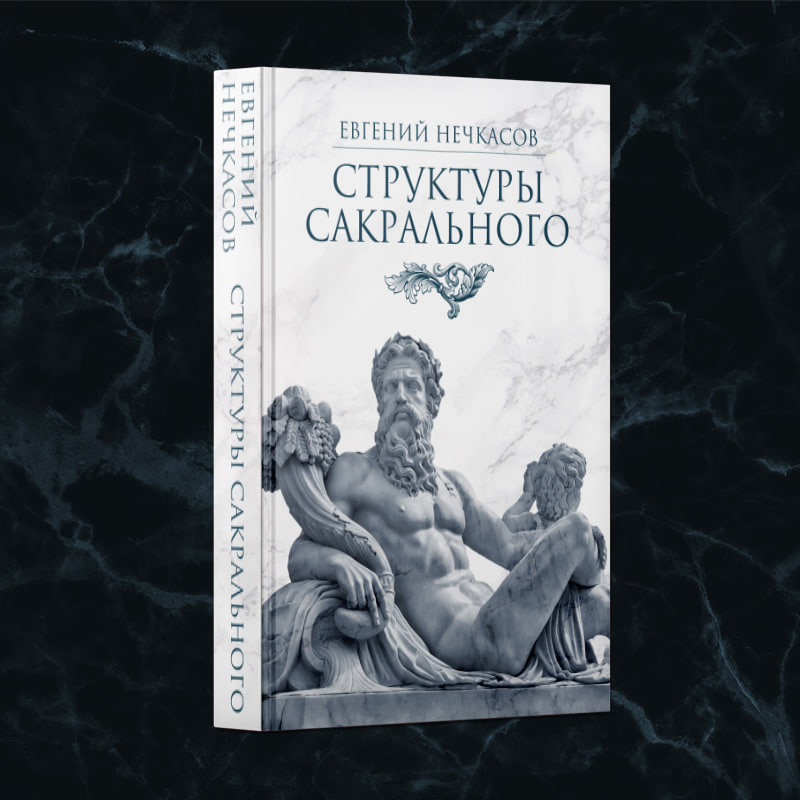
The book is based on three of the author’s lecture courses, developed and published in 2019–2021 with a duration of 28 hours and containing hundreds of diagrams, illustrations, and photographs. For this book, we selected and used the best, most necessary and graphically illustrative structures of the schema presented therein. The lecture texts were also revised, polished, and coordinated to match up with our other and later books.
The lecture series themselves are the result of more than 10 years of the author’s theoretical and polemical research, engaged practical experience in the milieux of followers of contemporary paganism, as well as numerous dialogues with representatives of various religions and confessions, traditional currents, and philosophical schools.
The book consists of three interconnected sections, each of which represents its own level of complexity and depth of immersion in the topics.
The textbook opens with short essays on theology, which at one time were addressed as an educational primer to the community of followers of contemporary paganism. In this work, the essays are assigned the role of a laconic introduction, in which the key fundamental topics are preliminarily described. The essays end with a list of necessary and prospective areas for further developing and deepening perspectives. Many of the announced topics have since been examined and worked out in detail within the framework of subsequent lecture courses and our other books.
The second block, which is directly concerned with the theory and structures of the sacred, is based on the lecture course of the same name “Man and the Sacred”. It is based on the classical division into the sacred and the profane, i.e., classical sacred dualism, or dvaita, with all the inherent cascade of binary oppositions. Although at certain points pertaining to cosmogony and language, we tried to illustrate the boundaries of this dualism and possible exits beyond it. This section should be considered as the main one, since the subsequent course of lectures draws on it while leaving behind some of its topics. We also decided to omit some of the repetitive illustrations and schematic blocks. In other cases, we return to key structures anew in order to place different emphases in them in correspondence with the approach that we call transgressive.
The textbook concludes with the most extensive and graphic block of lectures on the “transgressive sacred”. Transgression is a gesture directed at the extreme limit and overcoming it. The principle of non-duality, or advaita, plays a significant role here. The focus of this course is on the most complex metaphysical questions and the other, non-standard interpretation of tradition, strictly tied to the current metaphysical conditions and understood in strictly eschatological tones. In the world of flowers, there are those that open in the spring, barely breaking through the last snow; but there are also those that wait for their hour and conditions much longer, blooming their color only in autumn. We can observe the same rhythm in the world of ideas, when a certain interpretation and reading of traditional motifs reveals itself and claims its rights only in the specifically negative conditions of the end times. In the case of the transgressive sacred, we find ourselves facing exactly this situation.
This third section is based on a course of lectures originally entitled “The Left Hand Path”. After many years, it must be acknowledged that the attachment of our theory to this label was unfortunate. Our discourse is built on other foundations and significantly exceeds the stereotypical Western esoteric “left-hand path” currents in complexity and metaphysical depth. In essence, they are all secondary derivatives of the same European occultism and Hermeticism wrapped in new languages of presentation, gothic and cyber culture, and the aesthetics of shock and kitsch from the turn of the 20th and 21st centuries. They do not have independent, original perspectives and value.
The reading on which we insist is most correctly described as a philosophical-theological and cultural theory of the Sacred.
Nevertheless, the lecture course also contains a consistent line of opposition of “right vs. left”, which is of an auxiliary and methodological nature. Since the opposition itself is more characteristic of the right pole, and the conventional left gravitates towards the removal of dualities and is resolved in advaita and apophaticism. The other axial binaries of this course are “chaos” and “cosmos”, “something” and “nothing”.
The conventional right pole, to which the first two sections of the book are devoted, tends to exclude or relegate everything transgressive to the periphery, into the shadows, whereas the left pole is inclusive, ambivalent and functions according to the principle of “to each his own”. To a certain extent, the characteristics of the conformist and non-conformist approaches are true for these two paradigms of the sacred, respectively.
The historical dialectic of these two paradigms can be described through the image of a father who passes on to his son the traditional craft knowledge of how to properly build a log house on his land and what sacrifices, customs, tools, nuances, etc., are needed. The son builds the log house, then teaches his son, who passes on the knowledge and skill to his sons and grandsons. Thus, the tradition is preserved and continued. But after many hundreds of years, the familiar ground underfoot becomes swampy and problems arise: the lower crowns of the house become damp and rot, the house is soaked with dampness, the walls begin to slant and slip in different directions on the softened soil. No healthy life for the family in such a log house is possible anymore. Now the man, the husband and father, faces a serious question: step back and radically rethink the precepts of the fathers, start driving piles and raising the house above the ground, or completely leave the land and go deeper into the forest. On the other hand, even upon changing the external customs of building the house, framed as they were in ancient times by rituals and blood sacrifices, the new approach also preserves the intention to build a house and dwell in it, on the earth and under the heaven around it. With a significant or even complete change of paradigm, the orientation remains unchanged, but to continue “doing it the old way”, despite the obvious, total deterioration of the environment and conditions, is foolish.
In fact, the transgressive sacred is a decision: whether to leave the swamp ground and move on, or to change the structure of mythopoetics to other tales and sacrifices (to change the construction and architectural principles of building the house) in order to continue one’s being. The general sacrocentrism remains unchanged while the optics of the gaze, the style and the content of the narration of the mythos are changing.
As experience shows, this idea is, despite its apparent simplicity, a significant stumbling block and a watershed between the two paradigms.
Within the framework of the lecture courses we cover a very wide range of traditions and religious and philosophical teachings — from ancient Indo-European classics through Antiquity to the medieval darshans of India, and further to modern Europe and completely new readings and reconstructions. We are either personally or indirectly acquainted with many of the contemporary authors and ideologists mentioned in our presentation, which simplifies our access to, understanding of, and ensuing exposition of their key ideas.
Some of the topics and themes may seem too esoteric to the reader by contrast to purely philosophical or theological thought. Skepticism and criticism of this is partially fair. Hence, another task of our textbook is to raise the level of discourse from naive soil to higher intellectual levels, especially in order to overcome the perception of contemporary paganism as something “esoteric”, and to reveal its deep intellectual foundations. As well as to mark out further potential and key directions of development. All of this is so that contemporary paganism, instead of being merely one form of new religious movements, might turn into a full-fledged episteme of knowledge, a paradigm of thinking. Overall, so that it might be just as it was in Antiquity and in India all the way down to our days with their wide range of complex metaphysical, theological, philosophical, and aesthetic schools.
But it must be acknowledged that it is impossible to cover every topic in its full scope or to fully immerse ourselves in the whole universe of any particular tradition or philosophy. Separate volumes or even series of books could be written on each topic covered. Therefore, our cultural and philosophical review is inevitably preliminary in nature and endeavors to map, mark, and illustrate the leading intentions.
We have tried to preserve the living language of the lectures throughout the book, and, in addition to diagrams and illustrations, we have provided photographs from the author’s personal archive and travels.
In conclusion, we propose to consider this book as an invitation to further work through and develop the themes, insights, intentions, and mood presented herein.
Evgeny Nechkasov
Spring 2025