



From the Translator and Publisher
Where does one write their innermost and utmost thoughts in private? We are accustomed to two words: “journal” and “diary.” Both come to us from Latin and etymologically refer to “day” and “light.” This seems to be an unfortunate coincidence, as most would agree that the norm is for an entry in a journal or diary to be made at night with only the faint light of a campfire, a lamp, a flashlight, or a candle guiding a shadowy hand to press dark ink upon a page which might never see the light of day. Moreover, in more than a few famous instances, the publication of a journal or diary is often accompanied by shock, controversy, and scandal over how the “dark,” “obscure,” “withheld” dimensions of a personality and life are brought to light, “exposed,” revealing the deep shadows of things evidently left concealed. Even the colors of momentous journals seem to be portending, such as Heidegger’s black notebooks or Jung’s black and red books.
The reader is likely now expecting the announcement of an at-last published and controversial journal. But we dare to offer and provoke at the same time: what follows is not one journal, but two, yet neither of them in full, but in selected excerpts.
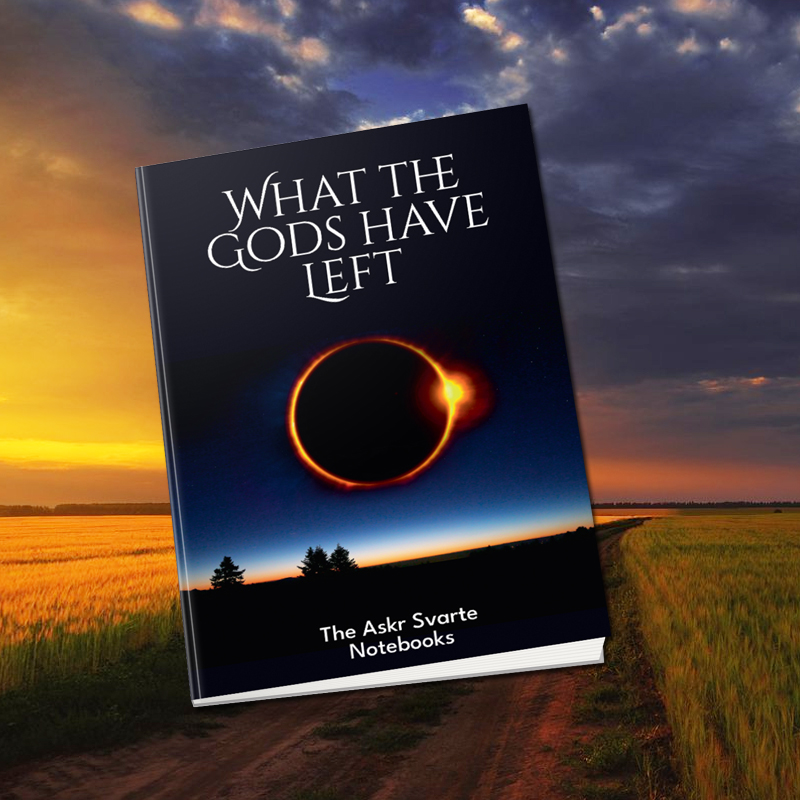
The pages that follow are extracts from two of the notebooks kept by Askr Svarte (né Evgeny Nechkasov). As for the first, entitled Schwarze Satori (“Black Satori”), the day following Yule 2021 saw the announcement that it would be privately printed and distributed in Russia in the form of a small booklet, deemed an “art project,” in February 2022. On the day of the launch of the Russian Special Military Operation in Ukraine, it was announced that the work had been delayed “due to technical issues.” Whatever might have happened thereabouts, the booklet that eventually arrived in our hands was dated “2022 era vulgaris,” measured 10.2 x 14.4 cm, and numbered 128 pages. We translate the synopsis that appeared on the back of the title page thusly: “A collection of aphorisms and uncompromising utterances on the paths of pagan tradition’s existence in the modern world.”
The second is called Ходы и мысли (“Ways and Thoughts”), a title which the preamble says came to Askr Svarte’s comrade in a dream and was then (re-)discovered in Heidegger’s Black Notebooks from 1942-48. Measuring 10 x 14 cm and counting 210 pages, it contains no synopsis, although the first public mention of it spoke of “a diary of entries about dissimilation and reflections on ongoing events.” This seemingly vague description was immediately appended with a qualification: “It won’t be released in Russia.” In May 2023, a copy was seen deposited by René Guénon’s grave in Cairo.
It is somewhat pointless to deem the content of these journals “controversial,” because they speak of and ponder things whose very existence and meaning the modern world denies. On these pages we encounter a thinker, born in the 1990s, in the era of the “End of History,” meditating on the situation of the ancient Gods, the fate of pagan traditions and tribes, the truth of myth, the destruction of technological civilization, the meaning of Being, and other “extraordinary” phenomena which the modern world disregards as senseless, delusional, impossible. Of course, this is nothing new to readers of Askr Svarte’s published works, but these journals restore the original sense of the “existential” to the lofty sense of the “metaphysical.” The lines and tones of Askr Svarte’s journals remind us that any grand philosophical tract is a formulation drawn from spiritual, intellectual, lived and living conversations of the soul brought to word on pieces of paper — just as these were penned in a wooden cabin in a forest in Siberia. In other words, we remember a powerful yet basic fact: the “esoteric” precedes as well as exceeds the “exoteric.”
Thanks are owed to the author for letting us translate and publish the glimpses that follow — and, as Heidegger suggested, we can only thank a thinker by thinking. As for the rest that has not been unveiled here, it would be far wiser, more promising, thoughtful, and beneficial to learn Russian, to seek out the corresponding contacts and worlds, and to experience the path of discovery on one’s own than it would be to receive a “full disclosure” as if there was nothing ambiguous or initiatic about encountering a Siberian thinker’s musings. And the “unsaid,” according to Heidegger, is the site and sighting where the meaning of Being awaits productive, creative, challenging revelation.
Another matter is the fact that even this small booklet already contains much more than much of the world is ready for, not to mention worthy of. A handbook with passages which rarely exceed a page or two is already more than enough — even more than what has come down to us from Heraclitus. The author, whose original thinking flowed without any pagination, has personally approved what has come down here.
Finally, with respect to the elected title, “what the Gods have left” calls for being interpreted in manifold ways, such as: “what the Gods have left behind [for us],” “what the Gods abandoned, fled, or condemned,” “what remains of the long gone Gods,” “what the Gods still have,” “what the Gods still hope for,” or even as “what from/of the Gods is left to be said,” etc. Mythopoetic sensitivity and thinking allow for so many more variations, interpretations, translations, and transmissions. But the very fact that there are Gods, in presence and/or in absence, and that there has been/is some kind of “leaving” — this, without any shred of doubt, is the essential apperception of all of Askr Svarte’s thinking and works, which in these excerpted journal entries we can now approach from unprecedented angles. Now, furthermore, these approaches appear specifically arranged in the form of a handbook, presented from one thinker to countless known and unknown fellow thinkers — a handbook that might be carried around, thought with, and serve as an initiation into so many other things that call for thinking.
Verily, in our day and age, it is truly something profound, ominous, and mysterious that “what the Gods have left” reaches us from Siberia, in the English language, and in the form of a pocket- sized book. The significance of this, we think alongside the author, speaks to and depends on very few — those few who might still wield the capacity to understand the overwhelming power of few words about what is truly “left” in a dying world flooded by idle chatter and millions of trees slaughtered to become pointless pages. In what follows there is, personally borne out, another world that currently exists in dramatic possibility.
— Jafe Arnold PRAV Publishing 1 June 2024