



Tradition and Future Shock: Visions of a Future that Isn’t Ours is a visionary work. It is a book which sees. The vision which the author of Tradition and Future Shock beholds is of a world – or rather a world rapidly becoming a “non-“ or “pseudo-world” – that was foretold in general, ominous terms by the ancient prophecies of sacred traditions, that was identified as the culminating “crisis” of our days by the 20th-century Traditionalists, and which has been vaguely sensed and thematized in numerous productions of “culture” within its Western frontier for decades, but whose contours and active processes are only now emerging with such blatant, self-advertising, open ferocity that anyone with a sense of cosmic trajectory would be dishonest not to recognize its merciless imminence. Tradition and Future Shock is a vision of the Kali-Yuga upon us in its extreme.
The main thrust of the Kali-Yuga described in Tradition and Future Shock is the overarching singularity of technogenic Modernity with the simulacra and “trans-isms” of Post-Modernity, a paradigm whose culmination entails the disintegration of the last remaining categories of “reality”: the world and the human. This is not some newfound “conspiracy” or machination in the voluntaristic sense, but the decrepit, poisonous, artificial fruit of a long process. Anticipated by the ontology of Abrahamic creationism which positioned man in a profane world beholden only to a transcendent God, Modernity and its technology destroyed the human’s multi-dimensional nature and multi-dimensional, sacred world and worldview. The living pluriverse, teeming with Gods and Goddesses, spirits, mythical creatures, and symbolic topographies was replaced with the profane fields of resource-extraction, calculated exploitation, and alienated res extensa. The human being as the bearer of the Divine, as the participant in the sacred cosmic processes of being and becoming, of life, death, and rebirth, of the celestial, the metamorphic, and the chthonic, was replaced with the physiological Human whose condition is one of rational distance toward the surrounding world, from which as much is to be extracted as possible. In this world, there is nowhere to go, nowhere and nothing to be, and nothing beyond its cynically self-enclosed shell. Under Post-Modernity, this pitiful, fixed “reality” dissipates in the throes of an “emancipation” which liberates neither the world nor the human, but the very process and “objectification” into which they have been reduced and subsumed. The “world” and the “human”, as they can now only be written with quotation marks, slide into the kaleidoscopic flux of the hypnoses of matter and technological manipulation in which everything that “is”, “is” only insofar as it “is” “plugged into” the evermore autonomous matrix of simulacral reproduction and “virtual reality.” This is the world of trans-humanism, object-oriented ontology, 3D printing, virtual reality, Artificial Intelligence, singularity, and the “Great Reset.” This world is not one of “humans” in any sense of the word, nor is it in any sense a “world” in which one can live and die organically, not to mention metaphysically. This “world” is the alienation of alienation itself, the de-humanization of de-humaned entities, the quasi-“worlding” of the “non-world”, in which there are no more “things” nor “consciousness”, but only the hyper-abundance and reign of the “accursed share” which, having no one to sacrifice it and nothing and nowhere to be sacrificed to, subsumes all and everything into amorphous coagulations of nothing-ness. In this “life”, even death loses any meaning and becomes an object of prevention and spectacle. What worth does this world have to anyone and anything beyond its own monotonic processing?
This brief glimpse cannot claim to do justice to Nechkasov’s genuinely panoramic, multi-leveled, at once inspirited and erudite account. Surveying immense fields of anthropological and economic studies, literature, cinema, and technologies, past and present, failed and successful manifestos of diagnosis and resistance, Tradition and Future Shock is an intense encyclopedic digest of the Kali-Yuga. If the presentation of Modernity and the deciphering of Post-Modernity are “no secret” and have been intimated from many perspectives by many astute authors over the past two centuries, then Nechkasov’s work is exceptional in its broad yet honed scope, its zooming in on the philosophical and technological moments since antiquity which have marked the perhaps little-remarked milestones of this course – a course whose summation threatens to induce that feeling evoked in the title, “future shock”, as well as another increasingly relevant confrontation which the author discusses in detail – the “uncanny valley.”
The uniqueness of Tradition and Future Shock’s account of the Kali-Yuga’s unfolding is its centralization of the question of technology as the fulcrum of momentum. Technology, Nechkasov argues, is not a neutral phenomenon or “instrument” which has accompanied man’s being-in-the-world since time immemorial. Such “instruments” have nothing to do with technology and were for millennia created in abidance by particular sacred understandings, prescriptions, and procedures which ensured such never assumed a “life of their own.” Technology as we “know” it, rather, is what Heidegger termed Gestell – “Enframing” – whose essence lies in the self-perpetuating overwhelming of human being by the imperatives generated by technical creations themselves. Man is no longer the crafter of tools whose creation and whose material origin reflect a higher or deeper dimension, but is the servant of machines which have no existential grounding, which are closed unto themselves as mechanized copies of one another, and whose functional maintenance becomes the condition of man’s lifestyle and living standards – a “living” that is now completely alienated from being-in-the-world. The Gestell has gone beyond the domain of material production to project its logic onto society, onto the human being, onto existence and the world overall. Modern man is suspended in an “enframing” which is constantly self-increasing, self-expanding, and whose “objectivity” now encompasses everything. That we lack the words to speak of this framing in terms which do not lend it any “subjectivity” or “identity-hood” testifies to the post-human horizon. Analytic philosophy, object-oriented ontology, speculative realism, and trans-humanism, among others, are Gestell’s philosophical overtures for its human objects.
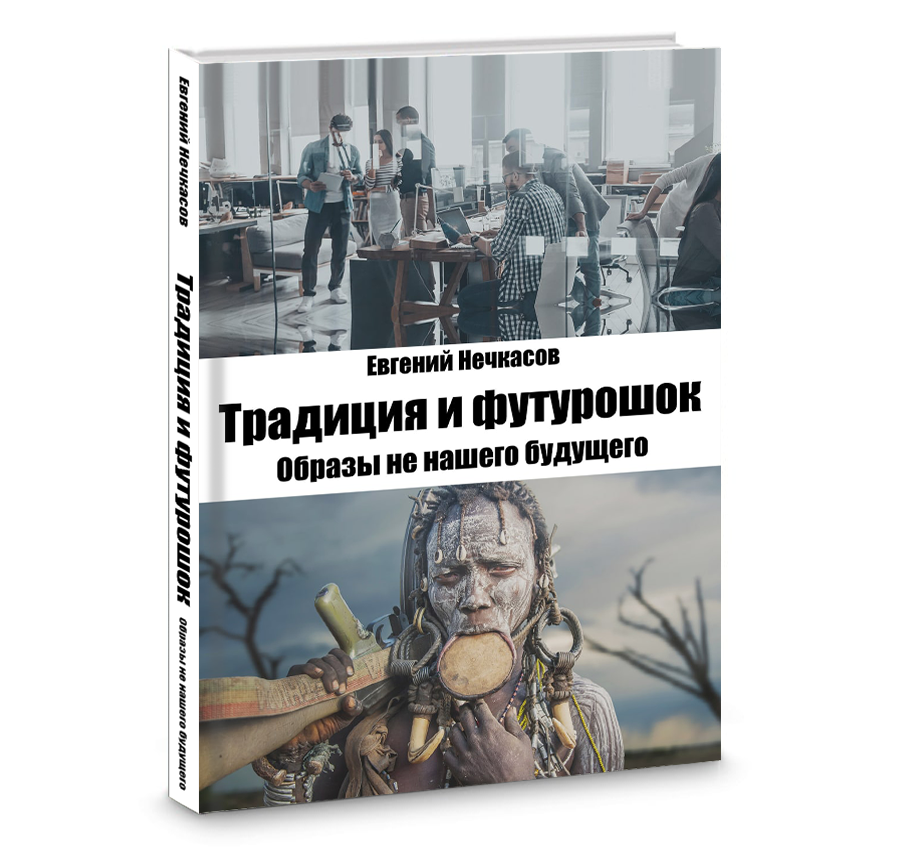
Nechkasov’s compelling study of technogenesis is based in the two most qualitative critiques to have emerged in opposition to Modernity: Traditionalism and the thought of Martin Heidegger. As a true Traditionalist, Nechkasov abundantly illustrates the qualitatively different constitution and understanding of “technology” in traditional societies, ranging from ancient Greece to archaic tribes in contemporary Africa, Latin America, Asia, and Polynesia. The critique of technology is firmly rooted in traditional myths and the renewed articulation of sacred worldviews. Employing Heidegger’s insights, Nechkasov correlates the trajectory of technology with subtle and paradigmatic shifts in the history of philosophy, the fundamental ontology of Being, and a phenomenology of world. At the same time, the author references and magisterially recapitulates numerous other studies and authors’ findings, particularly from the field of cultural anthropology.
Tradition and Future Shock, as the title leaves no doubts, is a work dedicated to Tradition. Nechkasov’s work in many respects continues – with refreshingly new expositions and interpretations as well as insightful critiques – the lines of exposing the qualitative differences between the Modern World and Tradition pursued by, first and foremost, René Guénon, Julius Evola, and Alexander Dugin. As the pioneer of Pagan Traditionalism, Nechkasov is first and foremost concerned with manifestationist Tradition, i.e., with the revelation of the Divine in the world, which is most acutely challenged – or, perhaps, made impossible – by Gestell, with the imperative of the regeneratio of rite and sacrifice, and with the incumbency of a new Golden Age. Directly confronting the technogenic Kali-Yuga means fulfilling the metaphysical due here and now. In moving towards outlining this due, Tradition and Future Shock embodies the confident meditation of Guénon’s Crisis of the Modern World and The Reign of Quantity and the Signs of the Times, the immense panorama of Evola’s Revolt Against the Modern World, the retrievals of the archaic of the works of Mircea Eliade, and the philosophical pathfindings of the works of Alexander Dugin. In its “manifesto” dimension, Tradition and Future Shock comes closest of all to being a Ride the Tiger for the present and henceforth generations of Traditionalists. In this regard, Nechkasov’s intimation of the unfolding Kali-Yuga far surpasses that of previous Traditionalist writings. In fact, it is difficult to call to mind any Traditionalist work which engages the relevant forms and challenges posed by the Kali-Yuga in such informed detail. This pertains not only to the relevance of contemporary forms, i.e., technological dimensions which previous Traditionalists could hardly have anticipated, but also the essential grounding of Nechkasov’s approach to the Kali-Yuga which draws from but goes beyond Evola’s recognitions in Ride the Tiger and the early metaphysical works of Alexander Dugin: the deepest fall of the Kali-Yuga poses the greatest imaginable opportunity for an ascendance and transcendental act. As is undoubtedly unavoidable in the later sections, Nechkasov’s work is oriented exclusively for the intellectual elite which is already prepared to follow its paths of thought, recognize its imperatives, and behold its vision in an apperception of scale and initiation which could only paralyze the un-initiated and attract the ire of those who do not understand – or, even worse, fully understand as opponents – the source of such provisions.
In light of the above qualification, we cannot dare to supply any glimpse into the scenarios and strategies which the author explores in the closing sections of the book. Without a doubt, some of them are already beyond the question of “desirability” or “feasibility”, and instead belong to the inevitability of impending circumstances and the personal equations of certain types who remain standing among the ruins. The latter “nuance”, or rather tension, emerges to the forefront of the consciousness underlying Tradition and Future Shock: how might the last remaining humans striving to re-embrace Tradition carry on in a post-human non-world in which even hitherto remote sanctuaries of the sacred text of nature are slated for destruction, where it will become necessary to test whether seekers are not plugged into the post-human matrix, and when even the Gods of Death and Destruction seem to have withdrawn just when their due would be most anticipated? By posing such questions and illustrating the eschatological tension that is definitive of the “present to be prolonged into tomorrow”, Nechkasov’s Tradition and Future Shock poses with unprecedented radicality the question of what it means to be a Traditionalist in the 21st century.